Your car body is one of the most visible features first, and
even a small scratch or dent can ruin its whole look. Whether it is a small
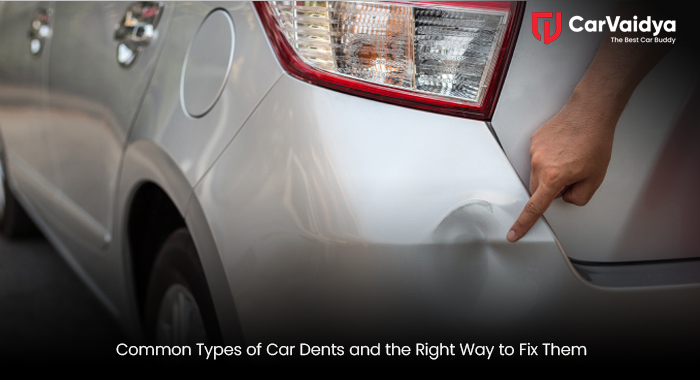
bumper scrape in a parking lot or a bigger dent caused by an accident, car
dents annoy every automobile owner. Understanding the various types of car
dents, their severity levels, and optimal dent repair methods saves you time,
money, and aggravation. Aside from dents, removing car scratches is also a
critical aspect of making your car look as good as new. Let's discuss the most
prevalent types of dents and the proper way to repair them.
1. Common Types of Car Dents
All dents are not the same. The severity of the damage varies
with the force, impact angle, and object. The following are the most typical
types of car dents:
a) Dings
- These are the least significant and most frequent dents,
usually due to shopping carts, pebbles, or car doors in tight parking lots.
Dings are shallow and less than half an inch wide.
b) Round Dents
- Mainly because of balls or hailstones, circular dents will be
circular in nature and can be of different sizes. They do not harm the paint
much, so they can be easily repaired.
c) Creased Dents
- These are the most serious and happen when a sharp object
rubs against the surface of the car. Creased dents usually have scratches
accompanying them, so car scratch removal is necessary when repairing them.
d) Sharp Dents
- Sharp dents occur when sharp objects such as bike handles or
metal poles come into contact with the car. They are deep but small, cracking
the paint and necessitating more sophisticated dent repair techniques.
e) Multi-point Dents
- Due to drops or falls, they span a large portion of the car
body. They are hard to repair and may require professional help in order to
straighten the surface completely.
2. Popular Dent Repair Techniques
After determining the dent type, you must choose the
appropriate dent repair methods. Depending on the severity and location,
different techniques are effective.
a) Paintless Dent Repair (PDR)
- One of the most popular modern techniques, Paintless Dent Repair is all about re-shaping the car's metal from the reverse side without
ever touching the paint. It's perfect for tiny dings, round dents, and minor
creases. PDR is cheap and won't harm the original paint, thus eco-friendly.
b) Traditional Dent Repair
- For cracks and chips in paint, PDR will not work. Here,
application of conventional methods like sanding, filling, and repainting the
area is the usual approach. Though time-consuming, it ensures that the
scratches and dent are repaired fully.
c) Heat and Cold Method
- For minor dents, hot water or a hair dryer is employed by
some amateurs to heat up the dent and subsequently ice it. The quick expansion
and contraction will sometimes force out the dent. It is not necessarily
guaranteed to work and can only be employed for extremely minor dents.
d) Dent Pulling Kits
- Sold in auto shops, the kits employ suction or glue-type
pullers to push out dents. They fix small and medium dents but are hard to use
without causing more damage to the paint.
e) Professional Body Shop Repair
- For multi-point or sharp dents, it is advisable to go to a
professional. Dent repair techniques such as PDR, repainting, and welding are
used by expert technicians to fix the car's surface.
3. Car Scratch Removal
Scratches are often accompanied by dents. Removing car
scratches effectively to prevent rust and enhance the aesthetic appeal of the
car can be achieved through the following methods:
a) Rubbing Compound
- Light surface scratches can be polished and incorporated into
the region using rubbing compound such that the scratch is almost invisible.
b) Scratch Repair Kits
- They can be bought in the market and are comprised of polish
and minor scratch cover-up applicators.
c) Touch-up Paint
- In case of deeper scratches that expose the metal or primer,
touch-up paint is needed. It is crucial to get the paint color match so a
smooth finish may be achieved.
d) Professional Polishing and Repainting
- Professional services ensure total removal of car scratches
by polishing, sanding, and repainting when it is severe.
4. Avoiding Car Dents and Scratches
While accidents can't be avoided, you can reduce the chances
of dents and scratches
- Park in less crowded areas to avoid door dings.
- Cover cars with car covers to protect from hail or debris
fall.
- Take care in tight parking spaces.
- Wash and wax your car regularly to coat the paint.
5. When to Have DIY vs. Professional Repair
- DIY repair like suction kits or rubbing compound is fine for
minor dings and scratches.
- Professionally fixing is recommended for deep dents, several
dents, or scratches that have moved beyond the paint layer.
- Knowing when to seek help will avoid you aggravating the
damage and spending more in the long run.
Every owner of a car will at some point in time experience
dents and scratches, but through proper knowledge, these need not be a cause of
concern. By finding out about the kinds of car dents and selecting proper dent
repair methods, you can maintain your car in as good as new condition. Don't
forget scratches either—timely car scratch repair not just improves appearance
but also protects your car from rust and severe damage. Using DIY techniques or
expert services, you can maintain your car's outside appearance stylish, valuable,
and safe for several years to come.
You can read some other articles
5
Common Car Problems That Can Be Fixed with Doorstep Car Service
How
Often Should You Replace Car Brake Pads? Expert Tips
How
to Increase the Lifespan of Your Car Brakes and Wheels
 By CarVaidya





0 Comments